
If your ultrasound report shows a fibroid measurement such as 30 mm, 50 mm, 70 mm or 100 mm, you may immediately wonder:
“Which size of fibroid is dangerous?”
The answer is not based on size alone.
There is no single fibroid size in mm that automatically means a fibroid is dangerous or needs surgery. A 30 mm (3 cm) fibroid can cause significant bleeding if it affects the uterine cavity, while a much larger fibroid may mainly cause pressure symptoms.
Doctors usually consider several factors together:
Size + Location + Number + Symptoms + Growth + Age + Fertility Plans
This guide explains which size of fibroid may need closer evaluation, what different fibroid sizes in mm and cm mean, when treatment may be needed, and whether a 3 cm, 5 cm, 7 cm or 10 cm fibroid is dangerous.
Which Size of Fibroid Is Dangerous?
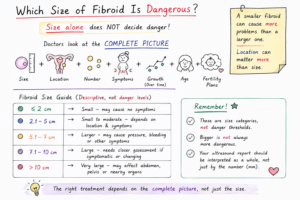
There is no universal size in mm or cm that makes a fibroid dangerous.
Fibroids are benign growths that develop in or around the muscular wall of the uterus. Some remain small and cause no symptoms. Others can become larger and cause heavy menstrual bleeding, pelvic pressure, pain, urinary symptoms or other problems.
The important point is that a larger fibroid is not automatically more dangerous than a smaller fibroid.
For example:
- A 30 mm (3 cm) submucosal fibroid may cause heavy menstrual bleeding because it affects the uterine cavity.
- A 50 mm (5 cm) fibroid may cause symptoms depending on its location.
- A 70 mm (7 cm) fibroid may cause pressure on the bladder or bowel.
- A 100 mm (10 cm) fibroid may cause abdominal enlargement or significant pressure symptoms.
Therefore, your ultrasound should not be interpreted by looking at the measurement alone.
Fibroid Size Chart in mm and cm
| Fibroid size | Approximate size in cm | What it may mean |
|---|---|---|
| ≤20 mm | ≤2 cm | Small fibroid; may cause no symptoms |
| 21–50 mm | 2.1–5 cm | Small to moderate; symptoms depend strongly on location |
| 51–70 mm | 5.1–7 cm | Larger fibroid; may cause bleeding, pressure or pain |
| 71–100 mm | 7.1–10 cm | Large fibroid; may need closer assessment, especially if symptomatic |
| >100 mm | >10 cm | Very large fibroid; may affect the abdomen, pelvis or nearby organs |
Important: These are descriptive size ranges, not universal “danger thresholds.”
A fibroid does not automatically become dangerous when it crosses 50 mm, 70 mm or 100 mm.
The size becomes more clinically important when it is associated with symptoms, a particular location, cavity distortion, pressure on nearby organs, significant growth or fertility concerns.
Which Size of Fibroid Is Dangerous in mm?
If you are specifically asking “Which size of fibroid is dangerous in mm?”, there is no single number that applies to every woman.
Fibroids are commonly measured in millimetres (mm) on ultrasound reports.
A useful way to understand the measurements is:
- 20 mm or less: Usually small
- 30 mm: 3 cm
- 50 mm: 5 cm
- 70 mm: 7 cm
- 100 mm: 10 cm
- More than 100 mm: More than 10 cm
But these numbers should not be treated as automatic danger points.
For fibroids around 3 cm or larger, clinical guidance recommends considering factors such as the size, location, number of fibroids and severity of symptoms when deciding on management.
This means a 30 mm fibroid with heavy bleeding may need more attention than a 70 mm fibroid causing no significant symptoms.
The ultrasound measurement tells you how large the fibroid is. It does not, by itself, tell you how serious it is.
Can a Small Fibroid Be Dangerous?
Yes, a small fibroid can still cause significant symptoms.
The most important example is a submucosal fibroid, which grows toward the inside of the uterus and can affect the uterine cavity.
Even when the fibroid is relatively small, it may contribute to:
- Heavy menstrual bleeding
- Prolonged periods
- Bleeding between periods
- Anemia caused by blood loss
- Fertility concerns in some women
This is why the question should not only be:
“How many mm is my fibroid?”
It should also be:
“Where is my fibroid and what is it doing?”
A 2–3 cm fibroid in one location may have a very different effect from a fibroid of the same size in another location.
Why Does Fibroid Location Matter?
Fibroid location can be just as important as its size.
The main types are:
Submucosal Fibroid
A submucosal fibroid grows toward the inside of the uterine cavity.
Because it can affect the uterine cavity, it may cause heavy menstrual bleeding and may be important when evaluating fertility.
A relatively small submucosal fibroid can therefore cause significant symptoms.
Intramural Fibroid
An intramural fibroid develops within the muscular wall of the uterus.
It is one of the common types of fibroids.
Symptoms depend on its size, exact position and whether it changes the shape of the uterine cavity.
Larger intramural fibroids may cause:
- Heavy menstrual bleeding
- Pelvic pressure
- Pain
- An enlarged uterus
Subserosal Fibroid
A subserosal fibroid grows toward the outer surface of the uterus.
Because it grows outward, it may cause pressure symptoms rather than mainly affecting menstrual bleeding.
Depending on its position and size, it may press against the:
- Bladder
- Bowel
- Rectum
- Other structures in the pelvis
Pedunculated Fibroid
A pedunculated fibroid is attached to the uterus by a stalk-like structure.
It may grow toward the inside or outside of the uterus.
Rarely, the stalk can twist and cause sudden severe pain. This requires urgent medical assessment.
Fibroid Size vs Location
| Fibroid feature | Possible concern |
|---|---|
| Small + submucosal | Heavy bleeding or fertility concerns |
| Intramural + larger | Bleeding, pressure or uterine enlargement |
| Large + subserosal | Pressure on bladder or bowel |
| Multiple fibroids | Combined effect on uterine size and symptoms |
| Any size + severe symptoms | Needs medical evaluation |
The exact effect varies from person to person.
Is a 30 mm (3 cm) Fibroid Dangerous?
Usually, a 30 mm (3 cm) fibroid is not dangerous based on size alone.
Many women with a 30 mm fibroid have few or no symptoms and may only need monitoring.
However, location matters.
A 30 mm submucosal fibroid may cause heavy menstrual bleeding because it affects the uterine cavity.
An intramural fibroid of the same size may cause different symptoms depending on its position within the uterine wall.
A subserosal fibroid may cause pressure symptoms if it grows toward nearby organs.
Therefore, a 30 mm fibroid should not automatically be considered dangerous or harmless without looking at the complete ultrasound and your symptoms.
Can a 30 mm Fibroid Cause Heavy Bleeding?
Yes.
A 30 mm fibroid can cause heavy or prolonged periods, particularly when it affects the uterine cavity.
If your periods are unusually heavy, last longer than usual, or are causing weakness, dizziness or anemia, speak with a gynecologist rather than judging the fibroid only by its size.
Is a 50 mm (5 cm) Fibroid Dangerous?
Not necessarily.
A 50 mm fibroid is 5 cm in size.
It is larger than a 30 mm fibroid, but 50 mm is not a universal danger or surgery cutoff.
Your gynecologist may consider:
- Where the fibroid is located
- Whether it affects the uterine cavity
- Whether you have heavy bleeding
- Whether you have pain or pressure
- Whether there are other fibroids
- Whether the fibroid has changed over time
- Whether you are planning pregnancy
A 50 mm submucosal fibroid may have a greater effect on bleeding than a similarly sized fibroid growing toward the outside of the uterus.
Does a 50 mm Fibroid Need Surgery?
Not automatically.
If a 50 mm fibroid is not causing significant symptoms, monitoring may be appropriate in some women.
If it is causing heavy bleeding, anemia, significant pain, pressure symptoms or fertility-related concerns, treatment may be discussed.
The decision is based on the complete clinical picture, not the 50 mm measurement alone.
Is a 70 mm (7 cm) Fibroid Dangerous?
A 70 mm (7 cm) fibroid is relatively large, but it is not automatically dangerous.
As a fibroid becomes larger, it may be more likely to cause pressure symptoms, depending on its location.
Possible symptoms include:
- Pelvic pressure or fullness
- Abdominal enlargement
- Heavy or prolonged periods
- Frequent urination
- Constipation
- Lower back discomfort
- Pelvic or abdominal pain
- Pain during sex
A 70 mm fibroid may also require closer evaluation if it is causing significant symptoms or affecting the uterine cavity.
Does a 70 mm Fibroid Need Surgery?
Not automatically.
Surgery may be considered if the fibroid is causing significant symptoms or other problems that cannot be adequately managed with observation or medication.
For some women, treatment may involve myomectomy or another procedure. For others, monitoring may be reasonable.
The appropriate treatment depends on the fibroid’s:
Size + Location + Number + Symptoms + Growth + Fertility Plans
Is a 100 mm (10 cm) Fibroid Dangerous?
A 100 mm fibroid is 10 cm, which is a very large fibroid.
However, 10 cm does not automatically mean cancer or automatically mean surgery.
A fibroid of this size may cause more noticeable pressure symptoms because it can occupy a significant amount of space in the pelvis or abdomen.
Possible symptoms include:
- Abdominal enlargement
- Pelvic pressure
- Heavy menstrual bleeding
- Pelvic or abdominal pain
- Frequent urination
- Difficulty emptying the bladder
- Constipation
- Lower back discomfort
The location of the fibroid remains important even at this size.
Does a 100 mm Fibroid Mean Cancer?
No.
A large fibroid does not automatically mean cancer.
Uterine fibroids are benign growths. Size alone cannot determine whether a uterine mass is cancerous.
If a mass is changing significantly, causing new symptoms or if the diagnosis is uncertain, further medical evaluation may be needed.
Do not try to determine whether a fibroid is cancerous simply by looking at its size in mm.
Does a 100 mm Fibroid Need Surgery?
Not every 100 mm fibroid requires surgery.
However, a fibroid this large may cause symptoms and can affect which treatment options are technically suitable.
Your gynecologist may consider:
- Its exact location
- Number of fibroids
- Symptoms
- Effect on nearby organs
- Growth pattern
- Age
- Fertility plans
- Overall health
What Symptoms Can a Large Fibroid Cause?
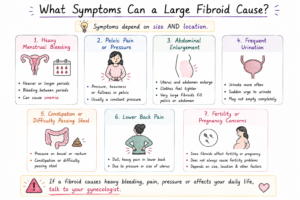
Some women with fibroids have no symptoms.
Others may experience:
| Symptom | How fibroids may contribute |
|---|---|
| Heavy periods | Fibroids can affect the uterine lining or cavity |
| Prolonged periods | Bleeding may continue for longer than usual |
| Pelvic pressure | Larger fibroids can press against surrounding structures |
| Abdominal enlargement | Very large fibroids can increase uterine or abdominal size |
| Frequent urination | Pressure on the bladder |
| Constipation | Pressure on the bowel or rectum |
| Pelvic pain | Fibroid position and size may contribute |
| Lower back pain | Pressure or pelvic changes |
| Pain during sex | Depending on fibroid location |
| Anemia | Heavy menstrual bleeding can lead to blood loss |
| Fertility concerns | Some fibroids can affect the uterine cavity |
Having these symptoms does not prove that a fibroid is the cause. Your gynecologist should evaluate other possible causes as well.
What Size of Fibroid Needs Treatment?
There is no single fibroid size that automatically requires treatment.
Treatment is generally considered when fibroids are causing significant symptoms or creating specific medical or fertility concerns.
Treatment may be discussed when there is:
- Heavy or prolonged menstrual bleeding
- Anemia caused by bleeding
- Significant pelvic or abdominal pain
- Pressure on the bladder or bowel
- Symptoms affecting daily life
- Significant or concerning changes over time
- Selected fertility or pregnancy concerns
- Uncertainty about the diagnosis
For fibroids around 3 cm or larger, treatment decisions should take into account the size, location, number and severity of symptoms.
This is different from saying that every fibroid above 3 cm is dangerous.
What Size of Fibroid Needs Surgery?
There is no universal size at which fibroid surgery becomes mandatory.
A fibroid may require surgery because of its symptoms, location or effect on the uterus, rather than because it has crossed one particular measurement.
Surgery may be considered when fibroids cause:
- Severe or persistent bleeding
- Anemia
- Significant pain
- Pressure symptoms
- Problems with daily activities
- Selected fertility concerns
- Significant uterine distortion
- Symptoms that do not improve with other treatments
The type of surgery depends on the size and location of the fibroid and the patient’s treatment goals.
Possible procedures include:
- Hysteroscopic myomectomy for selected fibroids affecting the uterine cavity
- Laparoscopic myomectomy for selected fibroids suitable for minimally invasive surgery
- Open abdominal myomectomy for selected larger or more complex fibroids
- Hysterectomy when removal of the uterus is appropriate
The goal is to choose the safest and most suitable treatment for the individual patient.
Can a Large Fibroid Be Removed Without Removing the Uterus?
Yes.
A procedure called myomectomy removes fibroids while preserving the uterus.
Myomectomy may be an option for women who want to preserve their uterus, including some women who may wish to become pregnant in the future.
The approach depends on:
- Fibroid size
- Number of fibroids
- Location
- Depth within the uterine wall
- Uterine size and shape
- Previous surgery
- Overall health
- Fertility plans
Not every large fibroid can be treated using the same surgical approach.
Can a Large Fibroid Be Removed by Laparoscopy?
Some large fibroids can be removed by laparoscopic myomectomy, but not every large fibroid is suitable for laparoscopy.
The surgeon may consider:
- Size of the fibroid
- Number of fibroids
- Exact location
- Depth within the uterus
- Size and shape of the uterus
- Previous abdominal or pelvic surgery
- Overall health
- Fertility plans
A 100 mm (10 cm) fibroid may be removable by laparoscopy in selected patients, but size alone cannot determine whether laparoscopic surgery is appropriate.
Ultrasound and, in selected cases, MRI may help the surgeon understand the fibroids and plan treatment.
How Are Fibroids Diagnosed?
Fibroids are commonly diagnosed using a combination of symptoms, examination and imaging.
Ultrasound
Ultrasound is one of the main tests used to evaluate fibroids.
It can help determine:
- Fibroid size
- Number of fibroids
- Location
- Uterine size
- Whether the uterine cavity is affected
A transvaginal ultrasound may provide detailed information about the uterus and fibroids when appropriate.
MRI
MRI can provide more detailed images of the uterus.
It may be recommended when additional information about the size, number, exact location or characteristics of fibroids is needed, particularly when planning certain treatments.
Previous Ultrasound Reports
If you have had an ultrasound before, keep the previous report.
Comparing scans can help your gynecologist understand whether a fibroid has remained stable or changed over time.
A change in size should always be interpreted together with your symptoms and other findings.
How Are Fibroids Treated?
Not every fibroid needs treatment.
If a fibroid is not causing significant symptoms, your gynecologist may recommend monitoring.
When treatment is required, the options can include:
Monitoring
Regular follow-up may be appropriate when symptoms are mild or absent.
Your doctor may recommend repeat imaging depending on your individual situation.
Medication
Medicines may help control symptoms such as:
- Heavy menstrual bleeding
- Menstrual pain
- Other related symptoms
Medication does not necessarily remove the fibroid itself.
Myomectomy
Myomectomy removes fibroids while preserving the uterus.
Depending on the fibroid, it may be performed through:
- Hysteroscopy
- Laparoscopy
- Open abdominal surgery
Uterine Artery Embolization
Uterine artery embolization reduces blood flow to fibroids, causing them to shrink over time.
It may be suitable for selected women, but treatment goals and future pregnancy plans should be discussed with a gynecologist.
Radiofrequency Ablation
Radiofrequency ablation uses heat energy to destroy or shrink fibroid tissue.
It may be suitable for selected patients depending on fibroid size, number, location and individual treatment goals.
Hysterectomy
Hysterectomy removes the uterus and is a definitive treatment for uterine fibroids.
Because the uterus is removed, pregnancy is no longer possible after the procedure.
It may be considered in selected women with severe symptoms or when other treatment options are not suitable.
Can Fibroids Become Cancerous?
Fibroids themselves are benign growths.
A large fibroid does not automatically mean cancer.
Similarly, a particular size such as 50 mm, 70 mm or 100 mm cannot be used to diagnose cancer.
If a uterine mass is changing, causing new symptoms or if the diagnosis is uncertain, your gynecologist may recommend further evaluation.
Does Rapid Fibroid Growth Mean Cancer?
Not necessarily.
Rapid growth alone does not prove that a fibroid is cancerous.
However, significant growth or new symptoms should be discussed with a doctor, particularly when the diagnosis is uncertain.
The important point is:
Do not judge whether a fibroid is cancerous based on size alone.
When Is a Fibroid an Emergency?
Most fibroids are not medical emergencies.
However, some symptoms require urgent medical attention.
Seek urgent medical care if you experience:
- Sudden severe pelvic or abdominal pain
- Very heavy vaginal bleeding
- Fainting or severe dizziness
- Severe weakness
- Severe pain with fever
- Severe pain with vomiting
- Sudden worsening of symptoms
Rarely, a pedunculated fibroid can twist and cause sudden severe pain.
Heavy bleeding can also lead to significant blood loss and anemia.
Do not wait for a fibroid to reach a particular size before seeking medical attention.
If you have sudden severe symptoms, the symptoms themselves are more important than the measurement on your ultrasound report.
Fibroid Size and Fertility
If you are trying to become pregnant, fibroid location may be particularly important.
Fibroids that distort or affect the uterine cavity can be more relevant to fertility than fibroids that do not affect the cavity.
For example, a relatively small submucosal fibroid may be clinically important, while a similar-sized fibroid growing outward may have a different effect.
The relationship between fibroid size and fertility is not simple, and there is not one universal size cutoff that predicts fertility problems.
If you are trying to conceive and have fibroids, your gynecologist can assess:
- Fibroid size
- Location
- Number
- Whether the uterine cavity is distorted
- Other fertility factors
- Your pregnancy plans
A Simple Way to Understand Your Fibroid Report
Instead of looking at only one number, ask these six questions:
1. How large is the fibroid?
For example:
30 mm = 3 cm
50 mm = 5 cm
70 mm = 7 cm
100 mm = 10 cm
2. Where is it located?
Is it:
- Submucosal?
- Intramural?
- Subserosal?
- Pedunculated?
3. How many fibroids are present?
One fibroid and multiple fibroids can have different effects on the uterus.
4. What symptoms are you having?
Pay attention to:
- Heavy bleeding
- Pain
- Pressure
- Urinary symptoms
- Constipation
- Abdominal enlargement
- Fertility concerns
5. Has the fibroid changed?
Comparing your current and previous ultrasound can help your doctor understand changes over time.
6. Are you planning pregnancy?
Your fertility plans can influence which treatment options are considered.
This complete picture is much more useful than the fibroid measurement alone.
Expert Perspective: Why Fibroid Size Can Be Misleading
Dr. Nidhi Mishra
Obstetrician and Gynaecologist, World Laparoscopy Hospital
When reviewing a fibroid ultrasound, the measurement is only one part of the assessment.
A 30 mm fibroid may be important if it affects the uterine cavity and causes heavy bleeding.
A much larger fibroid may mainly cause pressure symptoms depending on where it grows.
The important factors include:
Size → Location → Symptoms → Number → Growth → Age → Fertility Plans
If a fibroid is causing heavy bleeding, anemia, significant pain, pressure on the bladder or bowel, or selected fertility concerns, treatment may need to be discussed.
At the same time, a large fibroid does not automatically mean that surgery is required.
The aim is to understand the complete clinical picture and choose an appropriate treatment for the individual patient.
Conclusion
So, which size of fibroid is dangerous?
There is no single size in mm or cm that automatically makes a fibroid dangerous.
A:
- 30 mm (3 cm) fibroid may cause significant bleeding depending on its location.
- 50 mm (5 cm) fibroid may or may not need treatment.
- 70 mm (7 cm) fibroid is relatively large but is not automatically dangerous.
- 100 mm (10 cm) fibroid is very large and should be evaluated carefully, but it does not automatically mean cancer or surgery.
The most important factors are:
Size + Location + Number + Symptoms + Growth + Age + Fertility Plans
If you have been diagnosed with a fibroid, do not judge your condition only by the number written on your ultrasound report.
Have You Been Told You Have a Fibroid?
If you are concerned about the size or location of your fibroid, Dr. Nidhi Mishra, Obstetrician and Gynaecologist at World Laparoscopy Hospital, can evaluate your ultrasound findings and symptoms and discuss the treatment options appropriate for your individual situation.
Book a Gynecology Consultation
Frequently Asked Questions About Fibroid Size
Which size of fibroid is dangerous?
There is no single fibroid size in mm that automatically means a fibroid is dangerous.
Doctors consider the fibroid’s size, location, number, symptoms, growth, age, menopausal status and fertility plans.
A smaller fibroid can cause significant bleeding if it affects the uterine cavity, while a much larger fibroid may cause few symptoms. Treatment is therefore based on the complete clinical picture rather than size alone.
Is a 30 mm (3 cm) fibroid dangerous?
Usually, a 30 mm (3 cm) fibroid is not dangerous based on size alone.
Many fibroids of this size cause no symptoms and may only need monitoring.
However, location matters. A 30 mm (3 cm) submucosal fibroid may cause heavy menstrual bleeding or affect fertility, while a fibroid in another location may cause few or no symptoms.
Is a 50 mm (5 cm) fibroid dangerous?
Not necessarily.
A 50 mm (5 cm) fibroid is moderate in size, but the measurement alone does not mean that it is dangerous or requires surgery.
Your gynecologist may consider its location, symptoms, number of fibroids and changes over time. A 50 mm (5 cm) fibroid causing heavy bleeding or significant pressure may need treatment, while an asymptomatic fibroid may be monitored.
Is a 70 mm (7 cm) fibroid dangerous?
A 70 mm (7 cm) fibroid is relatively large, but it is not automatically dangerous.
It may cause symptoms such as heavy bleeding, pelvic pressure, abdominal enlargement, frequent urination or constipation, depending on its location.
Whether it needs treatment depends on the symptoms, location, growth and individual circumstances—not simply the 70 mm measurement.
Is a 100 mm (10 cm) fibroid dangerous?
A 100 mm (10 cm) fibroid is very large and should be evaluated carefully, but it does not automatically mean cancer or surgery.
A fibroid of this size may cause abdominal enlargement, pelvic pressure, bladder or bowel symptoms, pain or heavy menstrual bleeding.
Your gynecologist will consider its location, symptoms, number, growth and effect on nearby organs before recommending treatment. Very large fibroids can sometimes enlarge the abdomen significantly.
What size of fibroid needs surgery?
There is no universal fibroid size at which surgery is automatically required.
Surgery may be considered when fibroids cause significant bleeding, anemia, pain, pressure symptoms, infertility or other problems affecting daily life.
The decision also depends on the size, location and number of fibroids, age, fertility plans, previous treatment and overall health.
Can a 50 mm (5 cm) fibroid cause heavy bleeding?
Yes, a 50 mm (5 cm) fibroid can cause heavy menstrual bleeding, depending on its location.
Fibroids that grow toward or affect the uterine cavity can be particularly important when heavy bleeding is present.
Heavy periods that interfere with daily activities or cause anemia should be discussed with a gynecologist.
Can a large fibroid become cancerous?
Most uterine fibroids are benign growths and are not cancer.
Size alone cannot determine whether a uterine growth is cancerous.
A fibroid that grows significantly, causes new symptoms or creates uncertainty about the diagnosis may need further evaluation. Importantly, rapid growth does not automatically mean cancer, but it should be assessed by a doctor when clinically concerning.
Can a large fibroid be removed without removing the uterus?
Yes. A large fibroid can sometimes be removed while preserving the uterus.
The procedure is called a myomectomy.
Depending on the fibroid’s size and location, myomectomy may be performed through laparoscopy, an abdominal approach or hysteroscopy for selected fibroids that grow into the uterine cavity.
Myomectomy can be an important option for women who want to preserve their uterus or may wish to become pregnant in the future.
Can a large fibroid be removed by laparoscopy?
Some large fibroids can be removed through laparoscopic myomectomy, but not every large fibroid is suitable for laparoscopy.
The surgeon considers the fibroid’s size, number, location, depth within the uterus and other individual factors before choosing the surgical approach.
An ultrasound or MRI may be used to understand the fibroids more clearly and plan treatment.
Can fibroids shrink on their own?
Yes, fibroids can sometimes become smaller, particularly around menopause, but they do not shrink in every woman.
Fibroids are influenced by hormones, and they often shrink when estrogen levels decrease during menopause.
Some medicines that reduce estrogen production can also temporarily shrink fibroids. However, fibroids may grow again after certain medicines are stopped.
Do fibroids affect fertility or pregnancy?
Some fibroids can affect fertility or pregnancy, but having a fibroid does not automatically mean you will have fertility problems.
The effect depends largely on the location and size of the fibroid.
Fibroids that affect the uterine cavity may be more important for fertility than fibroids that do not distort the cavity.
Fibroids can also be associated with pregnancy complications in some women. If you are trying to conceive and have fibroids, your gynecologist can assess whether the fibroids may be contributing to fertility or pregnancy concerns.