
There is no single ovarian cyst size that automatically means a cyst is dangerous. However, size is an important part of how doctors decide whether a cyst needs monitoring, further testing or treatment. Before menopause, simple cysts under 5 cm are often managed conservatively, cysts measuring 5–7 cm usually need follow-up, and cysts larger than 7 cm may require further imaging or specialist assessment. A 10 cm cyst is very large and should be evaluated carefully.
But size is only part of the picture. Ultrasound appearance, cyst type, symptoms, growth and whether you are before or after menopause can change what a particular cyst means.
Below, we explain ovarian cyst sizes in mm and cm, when a cyst may need surgery, warning signs that require urgent medical attention, and what different ultrasound findings mean.
What Size of Ovarian Cyst Is Dangerous in MM?
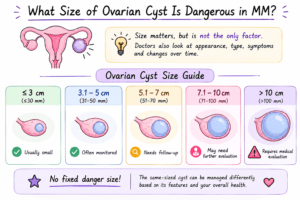
Size is important, but it is not enough to determine whether an ovarian cyst is dangerous.
Many ovarian cysts are benign and may disappear without treatment. Doctors usually consider the cyst’s size together with its ultrasound appearance, type, symptoms and whether it changes over time.
Ovarian Cyst Size Guide
| Ovarian cyst size | What it may mean |
|---|---|
| ≤30 mm (≤3 cm) | Usually small; its significance depends on the person’s age, symptoms and ultrasound findings |
| 31–50 mm (3.1–5 cm) | Many simple cysts may be monitored, particularly before menopause |
| 51–70 mm (5.1–7 cm) | A larger cyst that may require follow-up depending on its appearance and the patient’s situation |
| 71–100 mm (7.1–10 cm) | A large cyst that may need further assessment or specialist evaluation |
| >100 mm (>10 cm) | A very large cyst that requires thorough medical evaluation and individualized management |
Important: These are general size ranges, not universal “danger thresholds.” The same-sized cyst can be managed differently depending on its appearance, symptoms, age and menopausal status.
For example, RCOG guidance for women before menopause states that a simple cyst measuring less than 50 mm (5 cm) will usually not require treatment, while a simple cyst measuring 50–70 mm (5–7 cm) is generally followed with ultrasound. Simple cysts larger than 70 mm (7 cm) may require further imaging or consideration of surgery.
What Makes an Ovarian Cyst More Concerning Than Its Size?
Two ovarian cysts can have the same size but require completely different approaches.
This is because doctors do not look at the measurement alone. They also assess what the cyst looks like, what type of cyst it may be, whether it is causing symptoms, and whether it is changing over time.
Cyst Type
The type of ovarian cyst can make a significant difference.
Common types include:
- Functional cysts – These are common during the reproductive years and often disappear without treatment.
- Hemorrhagic cysts – These occur when bleeding happens within a cyst.
- Endometriomas – These are associated with endometriosis.
- Dermoid cysts – These are usually benign and can contain different types of tissue.
- Complex cysts – These may contain blood, septations or solid-appearing areas and may require closer evaluation.
Functional cysts commonly resolve on their own within several weeks, while other types may need monitoring or treatment depending on their characteristics.
Ultrasound Appearance
An ultrasound can provide much more information than the cyst’s size alone.
Doctors may assess whether the cyst is:
- Simple or complex
- Mainly fluid-filled or contains solid areas
- Associated with septations
- Associated with nodules or other concerning features
- Changing in size or appearance
Ultrasound can show the size, shape and location of an ovarian cyst and whether it is filled with fluid or contains solid components.
This is why two cysts measuring the same number of millimetres may not have the same clinical significance.
Symptoms
Some ovarian cysts cause no symptoms at all.
Others may cause:
- Pelvic or lower abdominal pain
- Pain during sex
- Changes in menstrual periods
- Bloating or abdominal swelling
- A feeling of pressure
- Frequent or urgent urination
- Feeling full quickly
Larger cysts can sometimes cause pressure symptoms or contribute to ovarian twisting. A cyst that bleeds or ruptures can cause sudden, severe pain.
Growth or Persistence
Doctors may also consider what happens to the cyst over time.
A cyst that becomes smaller or disappears may be managed differently from one that continues to grow or remains present over several menstrual cycles.
Persistent or enlarging cysts may require further evaluation because they are less likely to be a temporary functional cyst.
Age and Menopausal Status
Age is another important part of the assessment.
Ovarian cysts are common before menopause, and most are benign. However, the evaluation of an ovarian cyst after menopause is different because the risk of ovarian cancer increases with age.
For example, current RCOG guidance states that a unilateral, unilocular simple ovarian cyst measuring 30 mm (3 cm) or less in a postmenopausal woman does not require routine follow-up.
This is why an ovarian cyst should always be interpreted in the context of the person’s age and complete ultrasound report.
Is a 30 mm (3 cm) Ovarian Cyst Dangerous?
Usually, a 30 mm (3 cm) ovarian cyst is not considered dangerous by size alone.
Before menopause, small simple ovarian cysts are common and often disappear on their own. RCOG notes that simple cysts measuring less than 50 mm (5 cm) usually do not need treatment when they are otherwise reassuring.
However, size is only one part of the assessment.
Your doctor may also consider the type of cyst, its appearance on ultrasound, your symptoms and your age.
If the cyst has concerning features, causes symptoms or does not resolve as expected, follow-up or further evaluation may be recommended.
After menopause, the approach is different. For example, current RCOG guidance states that a simple, unilateral and unilocular ovarian cyst measuring 30 mm (3 cm) or less does not require routine follow-up in postmenopausal women.
Is a 50 mm (5 cm) Ovarian Cyst Dangerous?
Not necessarily.
A 50 mm (5 cm) ovarian cyst does not automatically mean that you need surgery or that the cyst is cancerous.
If the cyst is simple and you have no concerning symptoms, your doctor may recommend monitoring rather than immediate treatment. RCOG guidance for women before menopause states that simple cysts smaller than 50 mm (5 cm) generally do not require treatment, while simple cysts measuring 50–70 mm (5–7 cm) are generally followed with ultrasound.
The situation can be different if the cyst is complex, persistent or causing symptoms.
Your doctor may also consider whether you are before or after menopause. The same cyst size can have different clinical significance depending on your age and other findings.
Is a 70 mm (7 cm) Ovarian Cyst Dangerous?
A 70 mm (7 cm) ovarian cyst is large enough to deserve careful medical assessment, but it is not automatically dangerous.
For a simple ovarian cyst before menopause, RCOG recommends follow-up for cysts measuring 50–70 mm (5–7 cm). For cysts larger than 70 mm (7 cm), further assessment such as MRI and/or surgery may be considered.
The ultrasound appearance is particularly important at this size.
Doctors may want to know whether the cyst is simple or complex, whether it contains solid areas or septations, and whether it is causing symptoms.
A 70 mm (7 cm) cyst also does not automatically mean cancer. Most ovarian cysts are benign, but a larger or persistent cyst may need more detailed evaluation.
Is a 100 mm (10 cm) Ovarian Cyst Dangerous?
A 100 mm (10 cm) ovarian cyst is very large and should be evaluated carefully by a gynecologist.
A cyst of this size may cause pressure or discomfort in the abdomen or pelvis. Larger cysts can also be associated with complications such as ovarian twisting, particularly when sudden symptoms develop.
The next step depends on the cyst’s appearance, symptoms, age, menopausal status and other clinical findings.
A very large cyst may require additional imaging or discussion about surgical treatment. However, large size alone does not mean that the cyst is cancerous.
ACOG notes that surgery may be recommended when an ovarian cyst is very large, causes symptoms or raises concern for cancer.
What Does an Ovarian Cyst Ultrasound Report Mean?
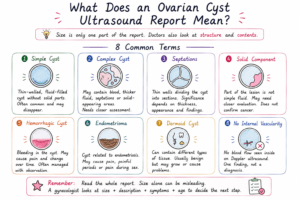
An ultrasound report can contain several medical terms that may be difficult to understand.
The size of the cyst is only one part of the report. Doctors also look at how the cyst is structured and what it contains.
Here are some common terms you may see.
| Ultrasound term | What it means |
|---|---|
| Simple cyst | Usually fluid-filled and thin-walled |
| Complex cyst | May contain blood, septations or solid areas |
| Septations | Internal divisions within the cyst |
| Solid component | Area that is not simple fluid |
| Hemorrhagic cyst | Bleeding within a cyst |
| Endometrioma | Cyst associated with endometriosis |
| Dermoid | Usually benign ovarian growth containing different tissue |
Remember: Read the Whole Ultrasound Report
It is easy to focus only on the cyst measurement.
For example, seeing 70 mm (7 cm) on a report may sound alarming. But the size should be interpreted together with the description of the cyst and the patient’s clinical situation.
If you have an ovarian cyst, do not judge its risk from size alone. A gynecologist can assess the complete ultrasound report and determine whether monitoring, additional testing or treatment is appropriate.
What Size of Ovarian Cyst Needs Surgery?
There is no single cyst size that automatically means surgery is required.
Surgery may be considered when a cyst is very large, continues to grow, causes significant symptoms or has concerning features on imaging.
Other situations may also require treatment, depending on the individual case.
Surgery may be considered when:
- The cyst is very large.
- It persists or continues to grow.
- It causes significant pain or other symptoms.
- It has concerning or complex ultrasound features.
- Ovarian torsion is suspected.
- The cyst has ruptured and there is significant bleeding or another complication.
- Cancer cannot be ruled out.
- Other clinical factors make surgery appropriate.
For example, RCOG guidance for simple ovarian cysts before menopause states that cysts larger than 70 mm (7 cm) may require further imaging such as MRI and/or consideration of surgery. However, this does not mean that every cyst above this size must be removed.
ACOG also notes that surgery may be recommended when an ovarian cyst is very large, causes symptoms or cancer is suspected.
Does Every Large Ovarian Cyst Need Surgery?
No.
A large cyst can still be benign.
Your doctor may recommend monitoring or additional imaging instead of immediate surgery, depending on the cyst’s appearance, symptoms, age and other clinical findings.
If surgery is recommended, the type of procedure will also depend on these factors. When a cyst is thought to be benign, minimally invasive surgery such as laparoscopy may be an option in appropriate cases.
Can a Large Ovarian Cyst Cause Complications?
A large ovarian cyst does not automatically cause complications.
However, larger cysts can sometimes put pressure on nearby organs or increase the risk of certain problems.
Ovarian Torsion
Ovarian torsion occurs when the ovary twists around the tissues that support it.
This can affect the blood supply to the ovary and may require urgent treatment.
A cyst can increase the likelihood of ovarian twisting. The pain may be sudden and severe, and it can occur with nausea or vomiting.
Ovarian Cyst Rupture
An ovarian cyst can sometimes rupture.
A rupture may cause sudden pelvic or abdominal pain. Some ruptures settle without major complications, while others can cause significant bleeding and require urgent medical assessment.
Sudden severe pain after a known ovarian cyst should not be ignored.
Pressure Symptoms
A larger cyst may press against nearby organs.
This can cause symptoms such as:
- Pelvic or abdominal pressure
- Bloating or abdominal swelling
- Frequent or urgent urination
- Changes in bowel movements
- Feeling full quickly
The presence and severity of symptoms can help your doctor decide whether further evaluation or treatment is needed.
When Is an Ovarian Cyst an Emergency?
The size of an ovarian cyst is not the only reason to seek urgent medical care. Sudden or severe symptoms are more important warning signs.
Seek urgent medical attention if you experience:
- Sudden, severe pelvic or abdominal pain
- Severe pain with nausea or vomiting
- Fainting or severe dizziness
- Heavy bleeding or symptoms that may suggest significant blood loss
- Fever with significant pelvic pain
- Sudden worsening of your symptoms
These symptoms can occur with complications such as ovarian torsion or a ruptured cyst.
ACOG notes that ovarian torsion can cause sudden pain and that cysts that bleed or burst can also cause sudden, severe pain.
Do not wait for a cyst to reach a particular size before seeking help if you have sudden severe symptoms.
Does a Large Ovarian Cyst Mean Cancer?
No. A large ovarian cyst does not automatically mean cancer.
Most ovarian cysts are benign, particularly before menopause. Many common ovarian cysts disappear without treatment.
Size alone cannot diagnose cancer.
Doctors also consider how the cyst looks on ultrasound, whether it is simple or complex, whether it is growing or persistent, the patient’s age and menopausal status, and other clinical findings.
Some cysts can become quite large while still being benign. For example, ACOG notes that cystadenomas can grow very large even though they are usually benign.
After menopause, ovarian cysts are assessed differently because the possibility of ovarian cancer needs to be considered more carefully.
If an ultrasound or other findings are concerning, your doctor may recommend additional tests or referral to a specialist.
The important point is that a measurement such as 70 mm (7 cm) or 100 mm (10 cm) should never be interpreted on its own. The complete clinical and ultrasound picture matters.
How Are Ovarian Cysts Diagnosed?
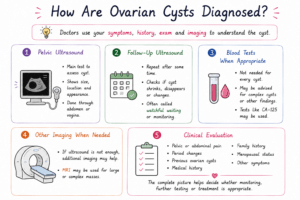
An ovarian cyst is often found during a routine examination or an imaging test performed for another reason.
Doctors use a combination of your symptoms, medical history, physical examination and imaging to understand the cyst.
Pelvic Ultrasound
Ultrasound is the main test used to assess an ovarian cyst.
It can show the cyst’s size, location and appearance. It can also help determine whether the cyst is mainly fluid-filled or contains solid areas.
An ultrasound may be performed through the abdomen or, when appropriate, through the vagina.
Follow-Up Ultrasound
Some ovarian cysts do not need immediate treatment.
Your doctor may recommend another ultrasound after a period of time to see whether the cyst has become smaller, disappeared or changed in appearance.
This approach is often called watchful waiting or monitoring. Many functional cysts resolve on their own.
Blood Tests When Appropriate
Blood tests are not needed for every ovarian cyst.
They may be recommended when the ultrasound shows a complex cyst or when there are other findings that require further assessment.
Depending on the situation, tests such as CA-125 may be used along with ultrasound and other clinical findings.
Other Imaging When Needed
If an ultrasound does not provide enough information, your doctor may recommend additional imaging.
For some larger or complex ovarian masses, MRI may be considered to provide more detailed information.
Clinical Evaluation
Your doctor may also ask about:
- Pelvic or abdominal pain
- Period changes
- Previous ovarian cysts
- Medical history
- Family history
- Menopausal status
- Other symptoms
The complete picture helps your gynecologist decide whether monitoring, further testing or treatment is appropriate.
How Are Ovarian Cysts Treated?
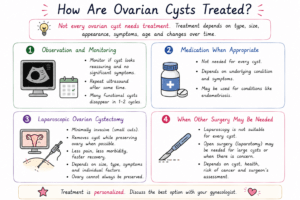
Not every ovarian cyst needs treatment.
The treatment depends on the cyst’s type, size, appearance, symptoms, age and whether the cyst changes over time.
The main approaches include monitoring, medication in selected situations and surgery when necessary.
Observation and Monitoring
If the cyst looks reassuring and is not causing significant symptoms, your doctor may recommend monitoring it rather than treating it immediately.
This may involve a repeat ultrasound after a recommended period.
Many functional ovarian cysts disappear naturally within one or two menstrual cycles.
Medication When Appropriate
Medication is not required for every ovarian cyst.
Treatment depends on the underlying condition and symptoms.
For example, medication may be used to manage conditions associated with ovarian cysts, such as endometriosis, rather than simply trying to make every cyst disappear.
Laparoscopic Ovarian Cystectomy
A laparoscopic ovarian cystectomy is a minimally invasive procedure used to remove an ovarian cyst while, when appropriate, preserving the ovary.
During laparoscopy, the surgeon uses a thin camera called a laparoscope through small abdominal incisions.
For ovarian masses that are considered suitable for minimally invasive surgery, laparoscopy is generally associated with less postoperative morbidity and a shorter recovery than open surgery.
The decision to perform a cystectomy depends on factors such as the cyst’s size, complexity, likely nature, symptoms and the patient’s individual circumstances.
When appropriate, the aim may be to remove the cyst while preserving healthy ovarian tissue.
However, preserving the ovary is not always possible or appropriate. The surgical plan should be discussed with the gynecologist before the procedure.
When Other Surgical Approaches May Be Needed
Laparoscopy is not suitable for every ovarian cyst.
Open surgery, known as a laparotomy, may sometimes be recommended when a cyst is very large, has features that raise concern, or when removing it safely through small incisions is not appropriate.
The choice of surgery depends on the cyst, the patient’s health, the possibility of malignancy and the surgeon’s assessment.
A Gynecologist’s Perspective: Why Ovarian Cyst Size Can Be Misleading
Dr. Nidhi Mishra, Obstetrician and Gynaecologist, World Laparoscopy Hospital
“When a patient comes to us with an ovarian cyst, we do not look at the size alone. We also look at the ultrasound appearance, type of cyst, symptoms, age, menopausal status and whether the cyst is changing over time.”
A cyst measuring 70 mm (7 cm) may sound alarming, but the measurement alone does not tell us whether it is dangerous.
A simple cyst and a complex cyst of the same size can require very different approaches.
We also consider whether the patient has pain, pressure symptoms or other concerns. In some cases, monitoring with a follow-up ultrasound may be appropriate. In others, further evaluation or treatment may be recommended.
The goal is to understand the complete clinical picture, rather than making a treatment decision based only on the number of millimetres.
About Dr. Nidhi Mishra
Dr. Nidhi Mishra is an Obstetrician and Gynaecologist with over 5 years of experience in women’s healthcare.
She specializes in gynecology, laparoscopic gynecological surgery and infertility management, with a patient-centered approach to diagnosis and treatment.
Her areas of expertise include ovarian cyst management, laparoscopic gynecological surgery, endometriosis, PCOS, menstrual disorders and infertility management.
She focuses on personalized, evidence-based care while prioritizing patient comfort and safety.
Conclusion
There is no single ovarian cyst size that automatically means danger.
A cyst measuring 30 mm (3 cm), 50 mm (5 cm), 70 mm (7 cm) or even 100 mm (10 cm) should be assessed in context.
Doctors consider its size, type, ultrasound appearance, symptoms, growth, age and menopausal status before deciding whether monitoring, further testing or treatment is appropriate.
Many ovarian cysts are benign and may disappear without treatment. Others may require closer follow-up or surgery.
If you have been diagnosed with an ovarian cyst, do not make a treatment decision based on its size alone. Discuss your complete ultrasound report with a qualified gynecologist.
Need an Evaluation for an Ovarian Cyst?
If you have an ovarian cyst or are concerned about your ultrasound report, Dr. Nidhi Mishra at World Laparoscopy Hospital can evaluate your condition and discuss the appropriate next steps based on your symptoms and scan findings.
Book a Gynecology Consultation
Frequently Asked Questions About Ovarian Cyst Size
What size of ovarian cyst is dangerous?
There is no single size that automatically makes an ovarian cyst dangerous.
Doctors consider the cyst’s size along with its type, ultrasound appearance, symptoms, growth and the patient’s age and menopausal status.
A larger cyst may need closer evaluation, but size alone does not mean that a cyst is cancerous or requires surgery.
Is a 50 mm (5 cm) ovarian cyst dangerous?
Not necessarily.
Many simple ovarian cysts measuring around 50 mm (5 cm) can be monitored, particularly before menopause.
Your doctor may recommend follow-up depending on the cyst’s appearance, symptoms and whether it changes over time. RCOG guidance notes that simple cysts before menopause measuring less than 50 mm (5 cm) generally do not require treatment, while cysts measuring 50–70 mm (5–7 cm) are generally followed with ultrasound.
Is a 70 mm (7 cm) ovarian cyst dangerous?
A 70 mm (7 cm) ovarian cyst is considered large, but it is not automatically dangerous.
The ultrasound appearance and your symptoms are important in deciding what happens next.
For simple cysts before menopause, RCOG recommends follow-up for cysts measuring 50–70 mm (5–7 cm), while cysts larger than 70 mm (7 cm) may require further assessment.
Is a 100 mm (10 cm) ovarian cyst dangerous?
A 100 mm (10 cm) cyst is very large and should be evaluated carefully by a gynecologist.
Your doctor may consider additional imaging or treatment depending on the cyst’s appearance, symptoms, age and other findings.
A 100 mm (10 cm) cyst does not automatically mean cancer. Some benign ovarian cysts can become very large.
What size ovarian cyst needs surgery?
There is no universal size at which every ovarian cyst needs surgery.
Surgery may be considered when a cyst is very large, continues to grow, causes significant symptoms, has concerning ultrasound features or when cancer cannot be ruled out.
The decision also depends on the patient’s age, menopausal status, fertility plans and the type and appearance of the cyst.
Can a large ovarian cyst go away on its own?
Yes, some large ovarian cysts can become smaller or disappear, but this depends on the type of cyst.
Many functional cysts resolve naturally within weeks or a few months.
A persistent, enlarging or complex cyst may need further assessment rather than simply waiting for it to disappear.
Does a large ovarian cyst mean cancer?
No. A large ovarian cyst does not automatically mean cancer.
Most ovarian cysts are benign, especially before menopause.
Doctors look at several factors, including the cyst’s ultrasound appearance, size, persistence, symptoms, age and menopausal status, when assessing whether further investigation is needed.
Can an ovarian cyst rupture?
Yes, an ovarian cyst can rupture.
A ruptured cyst may cause sudden pelvic or abdominal pain. Some ruptures may settle without major complications, while others can cause significant bleeding and require urgent medical attention.
Sudden severe pain, particularly with dizziness, fainting or other concerning symptoms, should not be ignored.
Can an ovarian cyst cause ovarian torsion?
Yes. An ovarian cyst can increase the risk of ovarian torsion.
Torsion happens when the ovary twists, which can reduce its blood supply.
It may cause sudden, severe pain on one side of the abdomen or pelvis and can occur with nausea or vomiting. This requires urgent medical evaluation.
Can ovarian cysts be removed through laparoscopy?
Yes, many ovarian cysts that require surgery can be removed through laparoscopy when the procedure is considered appropriate.
Laparoscopy is a minimally invasive approach that uses small abdominal incisions and a thin camera called a laparoscope.
For a cyst that appears benign, laparoscopic cystectomy may allow the surgeon to remove the cyst while preserving healthy ovarian tissue when appropriate. However, very large cysts or cysts with concerning features may require a different surgical approach.